By: Sougata Pal | AGM-HSE | Rashmi Metaliks Limited
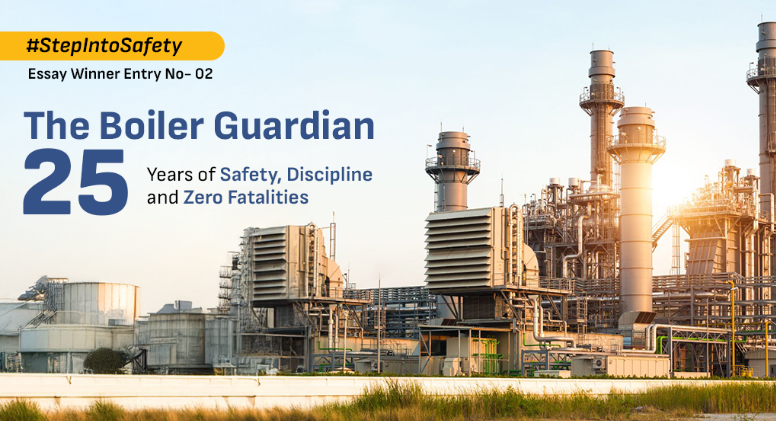
Title: The Boiler Guardian: 25 Years of Safety, Discipline, and Zero Fatalities
The Boiler Guardian: Sougata Pal’s 25-Year Mission for Zero Fatalities in Power Plants
How Mr Sougata Pal’s disciplined approach has redefined boiler safety in Indian power plants.
The safe and efficient operation of high-pressure boilers is one of the most critical — and riskiest — tasks in power generation. Running under extreme temperature and pressure, boilers demand a rigorous, technically sound regimen of inspection, testing, monitoring and continuous improvement. Three pillars anchor this approach: hydrostatic testing, tube thickness measurement, and comprehensive health and integrity checks. Together, they form the backbone of modern preventive and predictive maintenance.
Mr Sougata Pal began his career after completing a Diploma in Thermal Power Plant from the National Power Training Institute, Nagpur, in 2000. He later obtained the Certificate of Proficiency as a Boiler Operation Engineer (BOE). Over the next 25 years, working across power plants in nine states, he has built a record that stands out in the industry: zero fatalities.
Hydrostatic testing: The first line of defense
Hydrostatic testing remains the fundamental safety verification. The boiler is filled with treated water and pressurized — typically to 1.25–1.5 times its design pressure. Using water minimizes stored energy and risk. The test exposes hidden flaws: micro-cracks, weak welds, flange leaks and structural deformations that are invisible during normal operation. A successful hydro test confirms the unit can safely handle operating pressures, especially after major maintenance such as tube replacement, welding repairs or overhauls.
Gradual pressurization, proper air venting and close monitoring during the hold period are non-negotiable. In this domain, Mr Pal has led over 1,200 hydrostatic tests across plants nationwide. Beyond flawless execution under varied conditions, he has mentored engineers and technicians in best practices, safety protocols and technical fundamentals — creating teams that can run hydro tests safely and effectively on their own. His emphasis on documentation ensures that every test yields data for future risk assessment. This creates a culture where safety is proactive, not reactive.
Tube thickness checks: Predicting failure before it happens
Boiler tubes in water walls, economizers, super heaters and reheaters face corrosion, erosion, scaling and thermal fatigue. Ultrasonic thickness testing is the industry’s go-to non-destructive method for tracking remaining wall thickness. Mr Pal’s data-driven approach — recording values across critical zones and comparing them with design baselines — helps engineers spot metal-loss trends and forecast remaining life.
That enables timely decisions on repair, replacement or derating — averting tube failures that could trigger forced outages or hazardous incidents. By analyzing thickness data across sections, he has pinpointed potential failure zones before punctures occur. Using Failure Mode and Effects Analysis (FMEA), he has systematically assessed risks, prioritized critical components and guided timely replacement of pressure parts. The result: fewer failures, higher reliability and stronger preventive maintenance. He also champions digital record-keeping, ensuring thickness data is trended over years. This long-term visibility helps management plan capital expenditure and shutdown schedules with precision. His teams don’t just measure — they interpret, predict, and prevent.
Holistic health checks: No detail too small
Beyond individual tests, a comprehensive boiler health and integrity protocol looks at the whole system. Internal checks of drums and headers target oxygen pitting, sludge and scaling. Mr Pal’s command over water chemistry parameters has helped teams take corrective action early, preventing chemistry-related damage.
Externally, refractory linings and insulation are inspected for cracks and heat loss. Safety interlocks and controls — safety valves, low-water cut-offs, flame scanners, gauge glass systems — are tested for responsiveness. Mr Pal is recognized for his clear grasp of these systems, ensuring they perform under all operating conditions.
Operational parameters are tracked just as closely: flue gas temperature, oxygen levels, blowdown TDS and furnace draft. Deviations often flag deeper issues. This 360-degree approach keeps plants compliant with the Indian Boiler Regulations (IBR) and global standards while boosting efficiency and reliability.
He insists on cross-functional audits where mechanical, electrical, and instrumentation teams jointly verify safety systems. This breaks silos and ensures no single point of failure is overlooked. His checklists have become templates adopted across multiple plants.
Safety as culture, not compliance
What sets Mr Pal apart is leadership that turns procedure into culture. His vision is simple: make safety an ingrained habit, not a checkbox. Under his watch, Permit to Work (PTW) systems have been tightened, isolation procedures strictly enforced, and hazard identification embedded in every job.
He marries safety with performance. Teams are trained to maintain detailed logs of thickness readings, hydro-test results and key parameters. By reading trends and catching early warnings, they act before problems escalate — cutting unplanned shutdowns and extending equipment life. Where issues arise, Root Cause Analysis using the 7 QC tools is applied to find the underlying cause and lock in corrective and preventive action.
Training and knowledge-sharing are central to his method. Regular safety awareness programs, damage audits and debriefs ensure lessons are captured and implemented. By aligning plant goals with safety goals, he has delivered better uptime, fewer incidents and stronger stakeholder confidence.
His toolbox talks before high-risk jobs are legendary among technicians — brief, sharp, and focused on “what can go wrong” and “how we stop it.” New engineers are paired with veterans under his mentorship model, accelerating skill transfer and embedding accountability.
A benchmark for the industry
The integration of hydrostatic testing, tube thickness monitoring and full-system health checks is vital for boiler safety. But when backed by consistent leadership and a lived safety culture, the impact is transformative.
Mr Sougata Pal’s 25-year, zero-fatality record — built on technical mastery, hands-on mentoring and proactive risk management — is a benchmark for the sector. It shows that operational excellence and an uncompromising safety record can, and should, go hand in hand.

Global Recognition
It is recorded in the World Excellence Book of Records that Sougata Pal is honoured for having provided excellent and efficient services for commissioning, operation, and maintenance of thermal power plants across 9 states of India, covering approximately 100 high-pressure boilers, for a period of 25 years. His impeccable safety record is highlighted by zero fatalities during this tenure, showcasing his commitment to safety and expertise in the field.
This Honor Is Conferred As A Symbol Of Exceptional Achievement And Global Excellence, Duly Verified By The Authority Of World Excellence Book Of Records.
His journey proves that safety is not a cost — it’s an investment. And in the high-stakes world of power generation that investment pays back in lives protected assets preserved, and reputations earned.