By: Sushil Kumar Gochhayat | Sr. Manager (Environment dept) | National Aluminium Company Limited
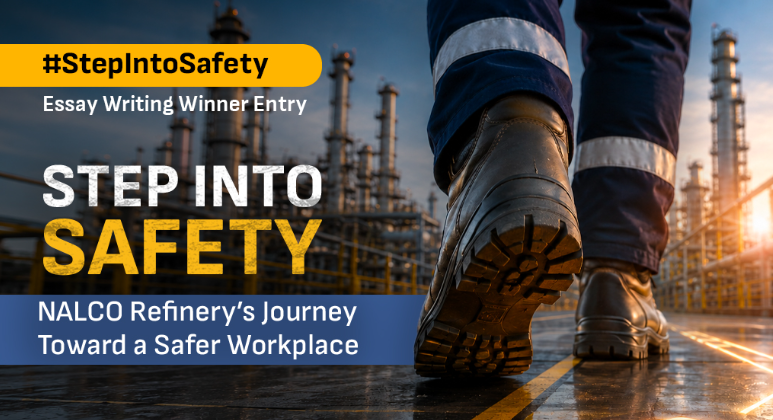
Title: Step Into Safety: NALCO Refinery’s Journey Toward a Safer Workplace
STEP INTO SAFETY: The Transformation of NALCO Refinery, Damanjodi
Introduction: A Silent Promise
Safety is often spoken of as a rule, a protocol, or a compliance requirement. But in reality, safety is far more than that—it is a silent promise every worker makes before stepping into the workplace: to return home unharmed. In an industrial setup like the NALCO Refinery at Damanjodi, where operations are intense and risks are inherent, this promise becomes even more significant. Every near miss, every safety improvement, every lesson from hazards, and every instance where Personal Protective Equipment (PPE) prevents injury contributes to a culture where safety is not enforced but lived.
The refinery at Damanjodi stands as a symbol of industrial excellence, but it also reflects the constant challenges of maintaining safety in a high-risk environment. At NALCO, we believe that no target is so important that we should compromise on the well-being of our people. This essay explores how we have moved from basic safety practices to a modern culture of care and responsibility.
The Reality of Industrial Hazards
The refinery environment is naturally demanding. One of the most prominent challenges is the operation of equipment under high temperature and pressure. Digesters, boilers, and pipelines carry materials at extreme conditions. A minor failure—a loose joint, a worn-out gasket, or an unnoticed crack—can lead to serious consequences such as burns or pressure bursts.
Equally significant is the challenge of handling chemicals. Substances like caustic soda, widely used in refinery processes, pose risks of skin burns, eye injuries, and respiratory problems. A moment of carelessness or improper handling can expose workers to hazardous situations. Alongside this, confined spaces such as tanks and vessels create invisible dangers. Limited oxygen levels and the presence of toxic gases make such areas potentially life-threatening without proper precautions.
Another everyday reality in the refinery is working at height. Maintenance and inspection tasks often require workers to climb structures, pipelines, and tanks. In the past, “monkey ladders”—simple vertical steel ladders—were commonly used. These were physically demanding and risky. Today, we understand that even a small lapse—such as a missing safety harness or a slippery surface—can lead to serious falls.
Beyond physical hazards, human factors such as fatigue, lack of communication, or overconfidence also contribute significantly to unsafe situations. Sometimes, the greatest risk is not the machine but the mindset.
The Teacher in the Shadows: Near-Miss Reporting
Among these challenges lies an often-overlooked aspect: near misses. These are incidents that could have resulted in injury or damage but did not, often due to sheer luck. Ignoring near misses is like ignoring warning signs—they are silent teachers, revealing weaknesses in the system that must be corrected.
Case Study: The Small Leak That Taught a Big Lesson
To understand the value of near-miss reporting, consider an incident during a routine inspection of a caustic liquor pipeline at the Damanjodi plant. A junior worker noticed a tiny, hair-like spray of liquid from a flange joint. It seemed insignificant, and he could have easily ignored it. However, guided by his safety training, he reported it immediately.
The maintenance team later discovered that the flange bolts had corroded due to prolonged exposure to a harsh environment. If left unattended, the joint could have failed under pressure, releasing hot caustic soda and causing severe injuries. Following this incident, the refinery replaced similar bolts with corrosion-resistant materials across the system.
This single observation prevented a potential disaster and reinforced a powerful truth: one alert worker can protect an entire workforce.
Initiatives for a Safer Workplace
What truly defines NALCO Refinery is not the presence of challenges, but the determination to overcome them. Several safety improvement initiatives have transformed the workplace into a safer environment.
A major step has been the promotion of a near-miss reporting culture. Workers are encouraged to report unsafe conditions without fear. This shift from a blame culture to a learning culture has been transformative.
The implementation of the Permit-to-Work (PTW) system ensures that every high-risk job is properly evaluated before execution. Whether it involves hot work, confined space entry, or maintenance activities, all potential hazards are identified and controlled in advance.
Engineering improvements have also played a crucial role. The replacement of risky monkey ladders with inclined staircases equipped with handrails has significantly reduced fatigue and fall risks.
Additionally, technology-driven safety systems—including gas detectors, alarms, and monitoring tools—provide real-time alerts, enabling quick preventive action.
Learning from the Frontline
The true strength of any safety system lies in its ability to learn. Every incident carries a message.
One key lesson learned at Damanjodi is that no hazard is insignificant. Small issues, if ignored, can escalate into major accidents.
Another important lesson is the need for strict adherence to procedures. Shortcuts may save time, but they compromise safety. Rules are not obstacles—they are safeguards designed to protect lives.
The importance of effective communication has also been reinforced. Clear instructions, proper coordination, and accurate handovers prevent misunderstandings and errors.
Ultimately, the refinery has embraced a simple but powerful principle: safety is everyone’s responsibility.
The Final Shield: Personal Protective Equipment (PPE)
While systems and lessons form the backbone of safety, the final line of defense lies in PPE. Though often unnoticed, it plays a critical role in saving lives.
Case Study: A Shield Against the Heat
A remarkable example comes from the Calcination area. A technician performing a routine check encountered an unexpected release of hot material from a side hatch. Fortunately, he was equipped with a heat-resistant suit, face shield, and heavy-duty gloves.
He walked away unharmed.
Later inspection revealed minor burn marks on the outer layer of his suit. Without PPE, those marks would have been severe injuries. This incident reinforced a crucial message: PPE is not just a requirement—it is protection in its truest form.
Helmets protect against falling objects, safety shoes prevent foot injuries, and gloves and protective suits shield workers from chemical exposure. PPE transforms potential tragedies into manageable situations.
The Power of Behavioral Safety
Beyond machines and equipment lies the most powerful factor—human behavior.
At NALCO Refinery, the adoption of Behavior-Based Safety (BBS) has reshaped the safety culture. Workers actively observe and guide each other, correcting unsafe practices in real time. This creates a sense of shared responsibility and mutual care.
Regular Toolbox Talks (TBT), training sessions, and mock drills keep workers alert and prepared. Over time, safety becomes not just a practice but a habit.
In this environment, knowledge becomes a shield, awareness becomes strength, and safe behavior becomes instinct.
Conclusion: A Journey Without an End
“Step into Safety” is not just a theme—it is a continuous journey. At the NALCO Refinery, Damanjodi, safety is embedded in every task, every decision, and every action.
The challenges are real, but so is the commitment to overcome them.
Every near miss reported, every unsafe ladder replaced with a safe staircase, and every lesson learned brings us closer to our ultimate goal—a workplace where everyone returns home safely.
Safety is not merely about avoiding accidents; it is about valuing life.
Let us not wait for incidents to remind us of its importance. Let us step into safety—consciously, responsibly, and wholeheartedly.